Here is the entire argument for building wealth, compressed into one line of Python:
>>> 1.01 ** 365
37.783
>>> 0.99 ** 365
0.026
That is it. That is the whole model.
A 1% daily improvement — in savings rate, in spending discipline, in financial habit — compounds to a 37.8× gain over one year. A 1% daily drift in the wrong direction — lifestyle creep, skipped contributions, deferred decisions — compounds to a 97% collapse. Not a setback. Not a dip. A near-total destruction of the original trajectory.
Two people can start in the same financial position on January 1st. One makes decisions that are fractionally better each day — automating savings, not inflating lifestyle with a raise, resisting the upgrade that felt necessary. The other drifts by an equivalent fraction — a subscription here, a delayed transfer there, a modest increase in spending each month that feels reasonable in isolation. By December 31st, the first person is at 37.8× their original financial velocity. The second is at 0.03×.
The gap between wealthy engineers and broke ones is rarely income. It is the sign on the exponent.
Why Your Brain Cannot Compute This
Human intuition was not built for exponential functions. We are linear thinkers by default — we add, we subtract, we estimate proportionally. When someone tells you they are 1% better every day, your brain translates that as “a little better,” which does not feel significant. When someone’s spending creeps 1% per month, it does not feel dangerous. It feels like rounding error.
This is the core failure mode. Compounding does not feel like what it is until the curve bends sharply, and by then it is too late to undo the accumulated effect.
The math, however, does not care what feels significant. The formula for compound growth is:
V(t) = V₀ × (1 + r)^tWhere r is the daily rate of change and t is time in days. At r = +0.01 and t = 365, the multiplier is 37.8. At r = -0.01 and t = 365, the multiplier is 0.026. The shape of the curve is identical in both cases — exponential — but one bends upward toward escape velocity and the other bends downward toward zero.
An engineer looking at this as a function immediately sees the sensitivity. Small changes in r produce enormous changes in the output at large t. This is not a rounding difference. It is the entire ballgame. And yet most people treat their daily financial decisions as if they are operating on a linear system where each choice has a fixed, proportional cost.
The Lollapalooza Effect
Charlie Munger spent decades explaining why intelligent people end up with mediocre outcomes: they evaluate forces in isolation rather than recognizing when multiple factors are aligned and compounding each other.
He called the opposite of this the Lollapalooza effect. When multiple reinforcing forces push in the same direction simultaneously, the result is not additive — it is multiplicative and explosive. The combined effect is far larger than the sum of the individual parts, because each force amplifies the others.
Applied to personal finance, the Lollapalooza effect explains why some portfolios grow at a rate that seems almost unreasonable to observers who are only modeling one variable at a time. They see a high-earner with a good savings rate and think “sure, they’ll do fine.” But the actual outcome is driven by multiple compounding layers stacked on top of each other:
- Time in the market — the base exponential from compound interest
- High savings rate — increases the principal being compounded
- Low expense ratio — reduces the drag on every return
- Behavioral consistency — eliminates the performance gap from panic selling and mistimed entries
- Automated systems — removes decision fatigue so the contributions happen regardless of motivation
Each of these forces compounds independently. But when they are all aligned, they compound each other. The high savings rate means more principal experiencing compounding. The behavioral consistency means that principal is never pulled out at the bottom. The automation means the savings rate stays high even when life is hard. The Lollapalooza is not a lucky outcome — it is what happens when you design a system where every force points in the same direction.
Conversely, the financial decline follows the same structure in reverse. Lifestyle creep (rising expenses) reduces the savings rate (less principal). The reduced savings rate creates anxiety around money (behavioral noise). The anxiety leads to impulsive decisions (mistimed moves). The mistimed moves produce underperformance (performance gap). Each negative force amplifies the others. The divergence from a positive trajectory is not one bad decision. It is a Lollapalooza working against you.
The Divergence Nobody Sees Coming
Here is the most dangerous feature of exponential compounding: the early trajectory is invisible.
Plot the 1.01^t and 0.99^t curves from day one — as shown below. For the first 30 to 50 days, the lines are nearly indistinguishable.
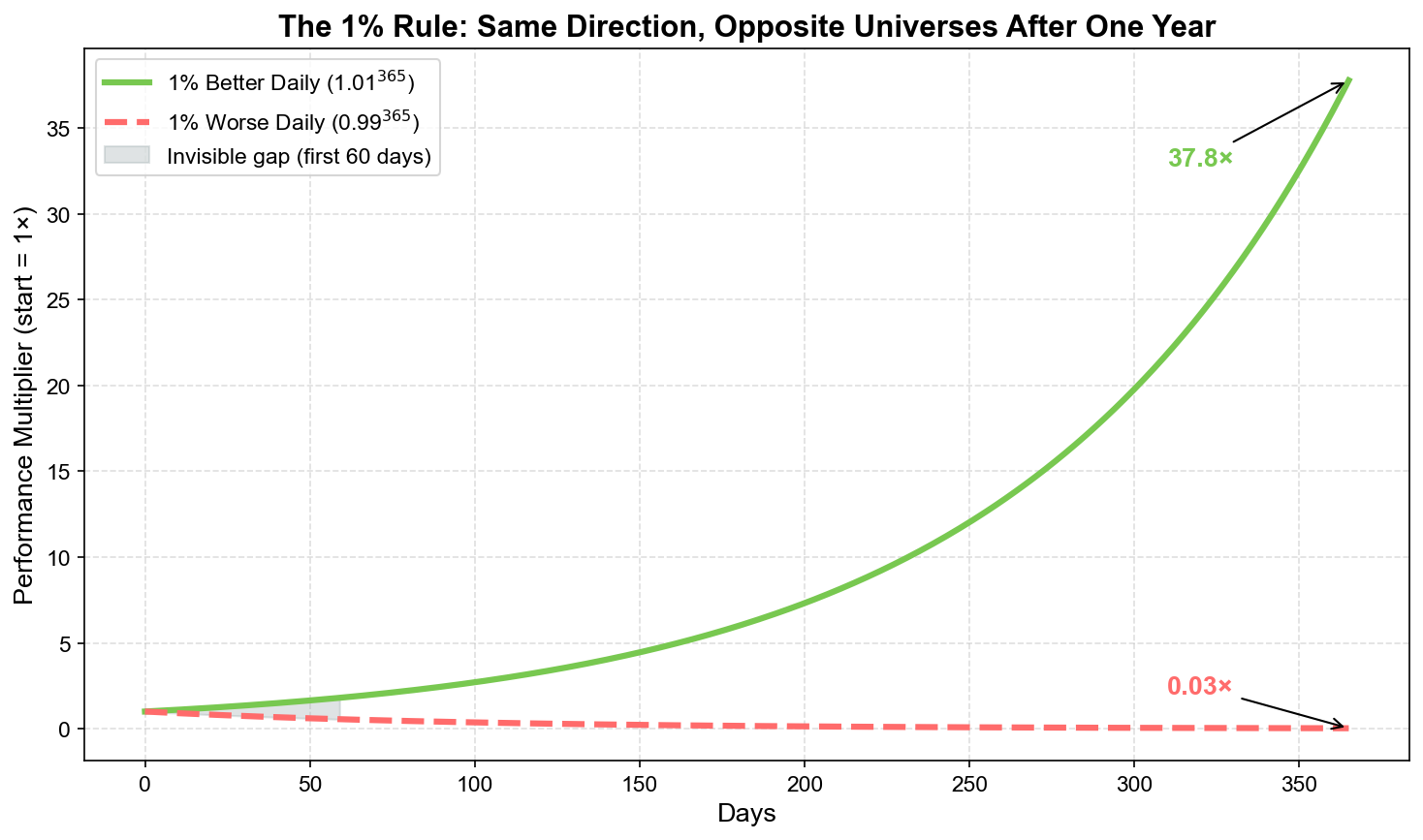 The 1% better line is barely above the baseline. The 1% worse line is barely below it. An observer watching both people in January would see no meaningful difference in their outcomes, their behavior, or their apparent trajectories.
By day 200, the divergence is visible but still feels explainable. “They had a good run” or “they had a bad stretch.” Both are superficial interpretations of what is actually an exponential process underway.
By day 365, the lines are in different universes. 37.8× versus 0.03×. No amount of course correction in December recovers the 11 months of compound drift.
This is precisely why the wealthy engineer and the broke engineer can look nearly identical in their 20s and be unrecognizable to each other by their 40s. The divergence is not dramatic at any single moment. It is the integral of hundreds of small decisions, each compounding silently in the background, each adding or subtracting from the exponent.
The divergence chart from Debugging Your Personal Finance makes this concrete: two lines starting from the same point in year zero, nearly overlapping through year two, visibly separating by year five, and occupying completely different scales by year ten. No dramatic event caused the separation. No single decision was the turning point. The compounding was always running — one curve up, one curve down.
The Habits That Compound Positively
Understanding the math is necessary but not sufficient. The question is which specific habits sit in the +1% category and which ones drift toward -1%.
Three habits have an outsized impact because they are structural — they change the system, not just a single decision:
Automated savings on payday. The single highest-leverage financial habit is also the simplest: move savings before you see the money. An automatic transfer on the day your paycheck arrives removes the variable of willpower entirely. You are not relying on discipline to save each month; you have engineered discipline out of the equation the same way a CI/CD pipeline removes the variable of a developer manually deploying every commit. The savings happen whether you are tired, whether the market is down, whether you had a hard week. The system executes regardless.
Savings rate increasing 1% with each raise. Every time your income increases, immediately redirect one percentage point more of gross income to savings before the lifestyle has time to adjust. If you get a 10% raise and your baseline savings rate is 20%, move to 21% savings before updating your spending budget. The lifestyle never experiences the raise. Your savings rate compounds upward. This one habit, applied consistently over a 20-year career, has a greater impact on financial outcomes than most investment strategies — because it keeps P and n both moving in the right direction simultaneously.
Expenses frozen while income grows. Related to the above, but distinct: when income increases, the default response is to expand the expense base proportionally. This is the mechanism of lifestyle creep — a 1% monthly drift that compounds toward 0.03× over time. The alternative is to treat income growth as savings growth, holding the expense baseline flat (or growing it only by inflation) while all incremental income flows into investment. This is the behavioral foundation of the savings rate that matters.
Each of these habits is not a single decision. It is a structural rule that generates compounding returns in the positive direction — compounding not just your money but your financial discipline, your savings rate, and your investment timeline simultaneously.
Wealth Is an Integral, Not a Moment
The most persistent myth in personal finance is that wealth comes from a moment of insight, a single correct investment decision, or a period of extreme sacrifice. The math says otherwise.
Wealth is not a discrete event. It is the integral of small, consistent system inputs over a long time horizon. The area under the curve — every day of positive compounding, every automated contribution, every percentage point of savings rate maintained — determines the final outcome far more than any single decision.
This is why the 1% rule is not motivational language. It is a function. The function has an input (your daily habit direction), a rate (the compounding factor), and a time variable (how long the function runs). You can solve for the output exactly. The output is either 37.8× or 0.03×, depending on the sign of r.
Engineers understand systems. They understand that a system with the right inputs, running correctly over a sufficient time horizon, produces the designed output reliably. The wealth-building system works the same way. The inputs are your savings rate, your behavior, and your automation. The time horizon is your career. The output — financial freedom or financial fragility — is a mathematical inevitability of the system you designed.
The only variable you actually control is which direction you compound in starting today.
This article is adapted from Chapter 1 of Debugging Your Personal Finance, which establishes the 1% compounding principle as the foundational operating model for wealth building. Chapter 9 translates this principle into a concrete capital allocation pipeline — the automated system that keeps compounding running in the positive direction without relying on monthly willpower.
Word count: ~1,550 | Tone: Analytical, engineering-first | Chapter source: Chapter 1 — Choosing Direction Over Destination